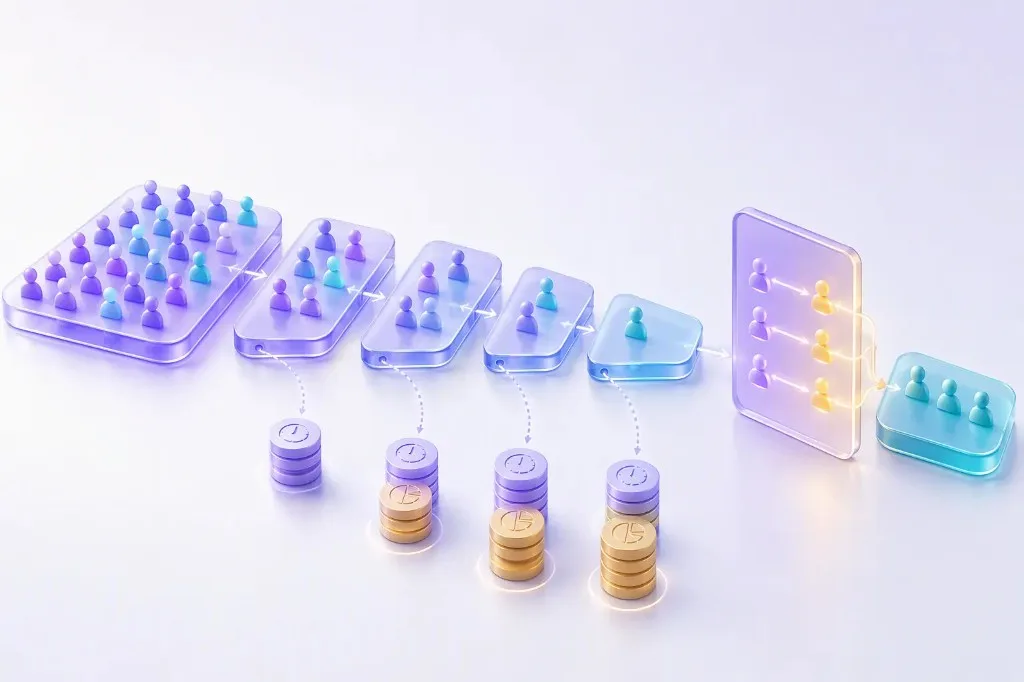
Can candidates cheat your soft skills assessment?
What the data shows
By WiseWorld

Most soft skills tests in hiring can be prepared for, except doing the job. About seven in ten job seekers now use GenAI on applications. Personality quizzes rank near ρ ≈ 0.19 for predicting job performance (Sackett et al., 2022). Work where you see how they use the skills finishes at 83%; AI interviews trigger 38% dropout (Greenhouse 2026). Compare prep risk, validity, and completion when candidates use ChatGPT.
Soft skills assessment in hiring: four questions worth asking
Most soft skills tests used in hiring can be prepared for — personality quizzes, fixed question banks, AI interviews, and rehearsed interview stories all expose a findable answer key. A live scenario built from your job description is the exception: the conversation branches on what the candidate says, so there is nothing to look up.
About seven in ten job seekers now use AI tools like ChatGPT on applications and interview prep. When everyone can look up how to pass your test, the test stops telling you who will actually do well on the job.
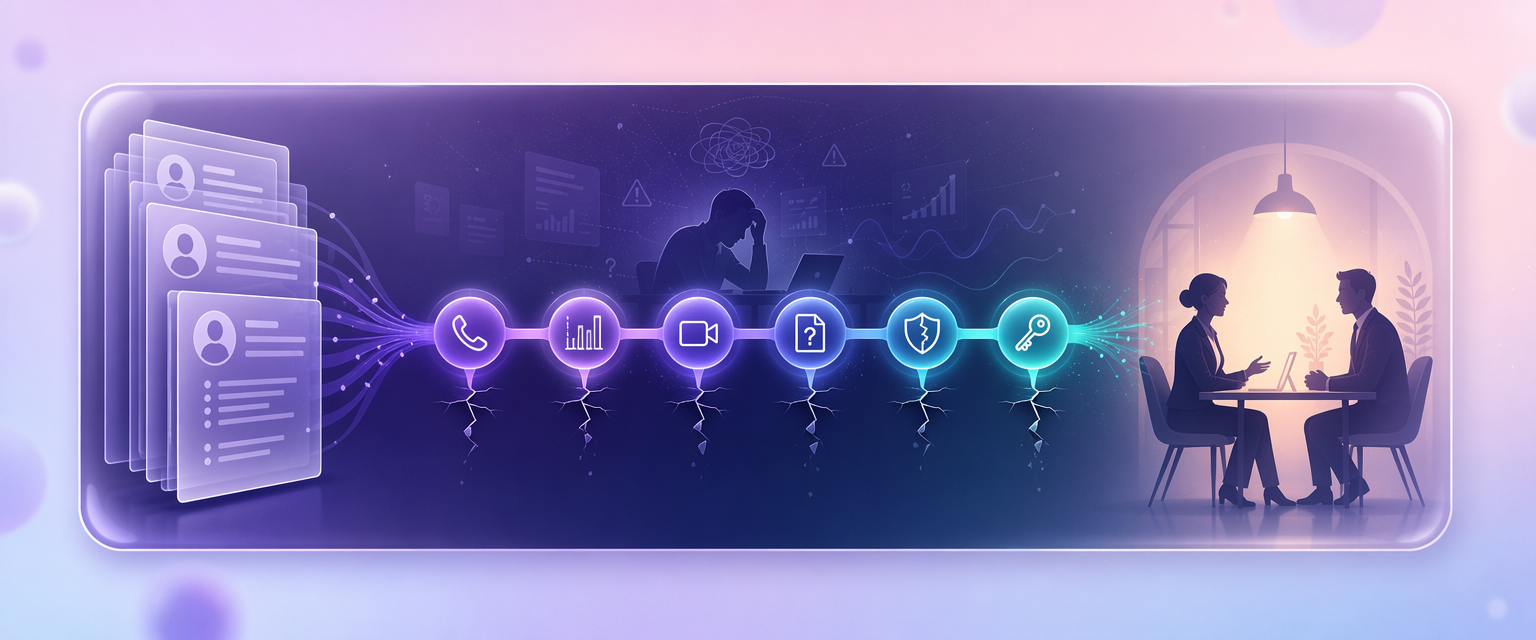
Four checks matter before you pick a tool: how easy it is to prepare for, whether it predicts performance, whether candidates finish it, and whether the answer key lives with you. For why phone screens, personality tests, and AI video all land in the same broken middle step, see our companion piece on six hiring funnel gaps.
In this article
Four checks: prep risk, prediction, completion, and whether the answer key is yours.
- Can candidates prepare for every soft skills test used in hiring?
- Which soft skills assessment methods actually predict a good hire?
- Which tests do candidates actually finish?
- Why is a scenario built from your job description the one they cannot look up?
Cheat-proof soft skills assessment: headline statistics
Key numbers on AI prep, AI interview dropout, and scenario completion.
- 7 in 10: Job seekers now prepare with AI tools
- 38%: Drop out when asked to do an AI interview
- 83%: Finish a realistic scenario task
Can candidates prepare for every soft skills test used in hiring?
People ask "Can candidates cheat with ChatGPT?" as if it were a yes or no question. It is more of a sliding scale. It comes down to one thing: does the test have a right answer that a candidate can find or guess ahead of time?
Here are the common tests, from easiest to prepare for down to hardest.
- A personality quiz. Candidates can sense which answers look good and pick those. This has been true for decades, and these quizzes are also the weakest at predicting who will actually do well.
- A set of fixed questions. Skills tests and questionnaires reuse the same questions for every company. Once questions are shared online, candidates can practise them.
- An AI interviewer. Candidates rehearse and re-record until it sounds smooth. It also puts them off. When one company required an AI interview, 38% of candidates dropped out rather than do it. For vendor-level context on one-way video and alternatives, see our HireVue alternative guide.
- A rehearsed interview story. The classic prepared answer. Coaches, online forums, and now AI all hand out the same STAR templates.
- Doing the job. They write, create, and hand off. You see how they use the skills in that work, scored against what matters for your role. There is no shared right answer to look up. Candidates can still do well or badly. They just cannot game a questionnaire, because they never see what you are weighting.
How easy each method is to prepare for or game
Higher bars mean more of the answer can be looked up, practised, or handed to AI. Scoring soft skills in the work is the hardest to game.
- Personality quiz: prep 88, cheat 72 (indexed 0–100)
- Skills test: prep 85, cheat 68 (indexed 0–100)
- Rehearsed stories: prep 78, cheat 55 (indexed 0–100)
- Scenario quiz: prep 62, cheat 48 (indexed 0–100)
- AI interviewer: prep 58, cheat 42 (indexed 0–100)
- Soft skills in the work: prep 18, cheat 12 (indexed 0–100)
Personality quizzes and skills tests cluster above 80 on prep risk in the index above. Scoring all 44 soft skills in the work sits near 18. Fixed forms land in the easy-to-game corner; using the skills on the job sits far from it.
Which soft skills assessment methods actually predict a good hire?
A candidate can prepare for a test and still be wrong for the job. Or struggle on a test and thrive once hired. The question here is different: does the method you use actually predict who will do well in the role?
Sackett et al. (2022) pulled together decades of hiring studies in the Journal of Applied Psychology. When someone scores well on a test, do they perform well on the job months later? Structured interviews and job-like tasks still sit at the top. Personality quizzes sit near the bottom. The gap between them is real.
Most teams choose a soft skills tool because it is fast, familiar, or already in the budget — not because of this research. If your assessment sits at the weak end of the chart, a polished shortlist may not mean much once the person starts.
How well each method predicts real job performance
Based on decades of hiring research (Sackett et al., 2022). Taller bar = more reliable prediction of who will do well on the job.
- Structured interview: 42
- Job simulation: 29
- Realistic scenario test: 26
- Reliability check: 25
- Personality quiz: 19
- Casual, unplanned interview: 19
The gap most teams are trying to close
Structured interviews rank highest; personality quizzes rank near the bottom yet remain common. Job simulations and realistic scenarios land in the middle and scale without a calendar slot for every applicant.
What teams actually run at this stage of hiring rarely matches the research ranking. The comparison table lines up common choices against what the evidence says about prediction.
The main ways teams check soft skills today, and where each one slips
Tool type, what teams like, and where candidates can prepare their way around it.
- AI interviewer (e.g. HireVue). Teams like: Scales well; used by large enterprises. Prep risk: Answers can be scripted; many candidates drop out; scoring feels like a black box
- Skills test libraries (e.g. TestGorilla). Teams like: Broad; fast to set up. Prep risk: The same questions go to every company, so they can be looked up and practised
- Personality quizzes (e.g. Predictive Index, SHL). Teams like: Familiar to buyers; quick to complete. Prep risk: Weak at predicting job performance; easy to answer the way you think they want
- Job simulations (e.g. ThriveMap, Vervoe). Teams like: Feel like real work; candidates like them. Prep risk: Scenarios come from a shared library, and candidates never see what you weight most
- Hiring games (e.g. Harver, Pymetrics). Teams like: Good for high-volume hiring; engaging. Prep risk: Abstract puzzles, not your job; concerns about fairness for some candidates
- Coding tests (e.g. Codility, HackerRank). Teams like: Strong signal on technical skill. Prep risk: Now easy to complete with AI; say nothing about teamwork or judgment
- WiseWorld. Teams like: Built from your job description; they do the work; all 44 soft skills scored in that work. Prep risk: Works best after you have checked the basics, like a resume or skills screen
Which tests do candidates actually finish?
A test that predicts well but nobody completes sends candidates back to your phone screen list. Completion matters as much as accuracy. Here is how candidates rate each method, and how many actually finish.
What candidates are happy to complete
IJSA 2025 favourability scale (1–7). Tasks that feel like the real job score highest; AI interviewers score lowest.
- A real work task: 5.04/7
- In-person interview: 4.91/7
- Realistic scenario: 4.65/7
- Personality quiz: 4.34/7
- AI interviewer: 3.36/7
Candidates rate a realistic scenario well above a personality quiz, and far above an AI interviewer, according to a 2025 review in the International Journal of Selection and Assessment. When a task looks like the actual job, it feels fair. People feel they had a real chance to show what they can do.
How many candidates finish, by method
Share of candidates who complete each type of assessment (Candidate Voice Report 2026 and industry synthesis).
- Live scenario / voice: 83%
- AI interviewer: 68%
- Form-based test: 64%
- AI chat interview: 60%
Live scenarios and voice tasks finish at 83%. AI interviewers sit at 68%. Form-based tests drop to 64%, based on the 2026 Candidate Voice Report. Every candidate who quits lands back on a recruiter's desk.
Why is a scenario built from your job description the one they cannot look up?
The usual fix for cheating is surveillance. Lock the browser. Track the candidate's eyes. That works for a coding test with one correct answer. It does nothing for soft skills, where what you care about is how someone uses those skills as they do the job.
A better fix is to remove the shared answer key entirely. When they do work from your job description, there is nothing to look up.
- Paste in your job description. WiseWorld reads it and maps the role to all 44 soft skills. This takes about 5.5 minutes, depending on how much your hiring manager wants to fine-tune.
- Set what matters most. This is your answer key, but it is not a list of correct options. It is a picture of which behaviours count most for this role. Two customer support jobs with the same title can look different here if one team needs someone calm under pressure and another needs a patient teacher.
- Send the work. Candidates write, create, and hand off. Every task comes from your job, not a shared library. You see how they use the skills in that work.
- Get your shortlist. One link goes to your candidates. They complete it on their own time in about 32.5 minutes. You get a ranked shortlist with a match score, a note on gaps, and suggested questions for the interview. Reviewing each one takes about five minutes.
WiseWorld: all 44 soft skills scored in the work
Typical recruiter and candidate time when all 44 soft skills are scored in the work.
- 5.5 min: To set up from your job description
- 44: All 44 soft skills scored for your role
- 32.5 min: For a candidate to complete
- 5 min: To review each candidate
The candidate knows they are being tested on soft skills in the work. What they do not know is which skills you value most for this job.
Take a team issue. One person might work through it with active listening: hearing both sides, reflecting back what they heard, and steering toward common ground. Another might use analytical thinking: naming the root cause, weighing tradeoffs, and proposing a clear next step. Both can be strong answers. Neither is automatically wrong. What separates them is fit with the soft skills profile you set for this role. If empathy and collaboration matter most here, the first candidate ranks higher. If structured problem solving matters more, the second one does.
WiseWorld scores every qualified candidate against your profile and ranks who matches best. There is no single script to memorize, only evidence of how each person actually uses the skills on the job. You review the shortlist on your own time instead of booking a manager to run the same conversation with each person.
WiseWorld's take: stop buying tests, start building yours
The prep economy runs on shared tests. When assessment comes from your own job, there is no leaked question bank, no model answer, and nothing to hand to ChatGPT the night before.
How do the main options compare on all four questions?
Once candidates start preparing with AI, does your soft skills test still tell you something real? That is the decision hiding behind prep risk, prediction, completion, and job specificity.
These are broad categories, not a rating of every vendor. Use them to see where your current tool sits, and what you would trade if you switched.
Methods compared on prep risk, validity, completion, and job specificity
Prep risk, prediction, completion, and whether the answer key is yours. Ratings are broad categories, not vendor-by-vendor scores.
- Personality quiz. Prep: Easy to prepare. Predicts: Weak. Completion: Medium (~64%). Answer key: Shared everywhere.
- Skills test library. Prep: Easy to prepare. Predicts: Moderate (skills only). Completion: Medium (~64%). Answer key: Shared everywhere.
- AI interviewer. Prep: Some prep possible. Predicts: Moderate. Completion: Medium (~68%; 38% quit). Answer key: Generic questions.
- Job simulation library. Prep: Some prep possible. Predicts: Moderate. Completion: High (~83%). Answer key: Shared library.
- Hiring games. Prep: Some prep possible. Predicts: Weak. Completion: Medium (~64%). Answer key: Not your job.
- Manager interview. Prep: Hard to game. Predicts: Strong. Completion: Low (needs a calendar). Answer key: Built from your job.
- WiseWorld (skills in the work). Prep: Hard to game. Predicts: Moderate to strong. Completion: High (~83%). Answer key: Built from your job.
Personality quizzes and shared skills tests score poorly on prep risk and prediction. They also use the same answer key for every company. AI interviewers and job simulation libraries do better on completion and feel more like work, but candidates can still rehearse against generic or shared content. Hiring games are engaging, but they rarely reflect your actual role.
A live interview scores well on prediction and uses your own bar for what good looks like. It does not scale to every applicant without blocking calendars. Scoring all 44 soft skills in the work is the only category here that scores well on all four checks without a manager in the room each time.
If your current tool sits in the easy-to-prepare column and weak on prediction, assume polished shortlists may not mean much once the person starts. If it finishes poorly, you are paying for dropouts with extra phone screens. If the answer key is shared, the prep economy already has a head start. The goal is not a perfect score on every check. It is knowing which weakness you are accepting, and whether that matches the role you are hiring for.
What this means for your hiring
Pre-interview soft skills assessment is standard now. The question is whether your test still tells you something real. Three checks before you buy or keep a tool:
- Look for a public answer key. If a tool sends the same questions to every company, or scores against a generic personality chart, assume the answers are already online.
- See the skills in the work. Soft skills for their own sake are meaningless. Job descriptions already describe how people should behave. Our study of European software engineer job posts found employers write actions, not adjectives. Score all 44 skills as they do that job, tuned by your hiring manager.
- Use it after the basics. WiseWorld fits in after a resume or skills check and before the manager interview. It substitutes questionnaires and weak quizzes, not your coding test or applicant system. The interview stays.
Vendors will keep adding features. The durable edge is a test candidates cannot rehearse for, because they have to use the skills on the work, and the answer key lives with you.
Further reading
Related WiseWorld research on screening methods, funnel gaps, and European job-post language.
- Phone screen vs self-paced screening (validity, completion, and recruiter cost by method)
- Pre-interview behavioral assessment guide: how they use soft skills as they do the job, before the manager interview
- Six hiring funnel gaps research: why phone screens, personality tests, and AI video land in the same broken step
- European job-post soft skills study: what employers actually ask for in job posts
- HireVue alternative guide: one-way video dropout, forum sentiment, and replacement options
Frequently asked questions
Can candidates prepare for every soft skills test used in hiring?
Most can, to varying degrees. Personality quizzes and fixed question banks are easiest to game. AI interviews can be rehearsed and re-recorded. A live scenario built from your job description is hardest to prepare for because there is no shared answer key and the conversation branches on what the candidate says.
Which soft skills assessment methods actually predict a good hire?
Structured interviews and job-like tasks rank highest in Sackett et al. (2022) meta-analyses. Personality quizzes rank near the bottom (ρ ≈ 0.19). Job simulations and realistic scenarios sit in the middle and scale without a calendar slot for every applicant.
Which tests do candidates actually finish?
Live scenarios and voice tasks finish at about 83%. AI interviewers sit at 68%, and form-based tests drop to 64%. Candidates rate realistic work tasks highest and AI interviewers lowest, according to IJSA (2025) and the 2026 Candidate Voice Report.
Why is a scenario built from your job description the one they cannot look up?
When the test comes from your job description and the conversation changes based on what the candidate says, there is no public answer key to find or hand to ChatGPT. What separates candidates is fit with the soft skills profile you set for the role, not a rehearsed script.
Where these numbers come from
Sources and limits for every number in this piece:
- How well methods predict job performance. Sackett, Zhang, Berry, and Lievens (2022) in the Journal of Applied Psychology. We show the results as simple bars rather than technical scores.
- How much candidates like each method. Zibarras, Castano, and Cuppello (2025) in the International Journal of Selection and Assessment, which asked 281 candidates to rate each method out of 7.
- How many candidates use AI. Greenhouse (2025) Workforce and Hiring Report, which found that 67% of US candidates use AI tools when job searching, including applications and interview prep.
- Why candidates drop out of AI interviews. Greenhouse (2026) Candidate AI Interview Report, where 38% of US candidates withdrew rather than complete an AI interview.
- How many candidates finish each test. The 2026 Candidate Voice Report from Recruiting Tech Reviews, based on 2,587 candidates.
- How easy each method is to game. Our own summary based on all of the above and on how these tools work in practice. This one is a guide to the general pattern, not a precise score.
- How the options compare across all four checks. Our synthesis of the sources above, mapped to prep risk, prediction, completion, and job specificity. Broad categories, not a vendor-by-vendor score.
- How WiseWorld works. Checked against the live WiseWorld recruitment product: paste your job description, set what matters, send scenarios, get a ranked shortlist.
- A note on limits. Tool prices and features change often. How well a method predicts performance can vary by role. For high-stakes hiring in regulated fields, always add your own legal review.
More in Recruitment
Latest on the blog