Pre-interview behavioral assessment
research, adoption, and how to run it
By WiseWorld
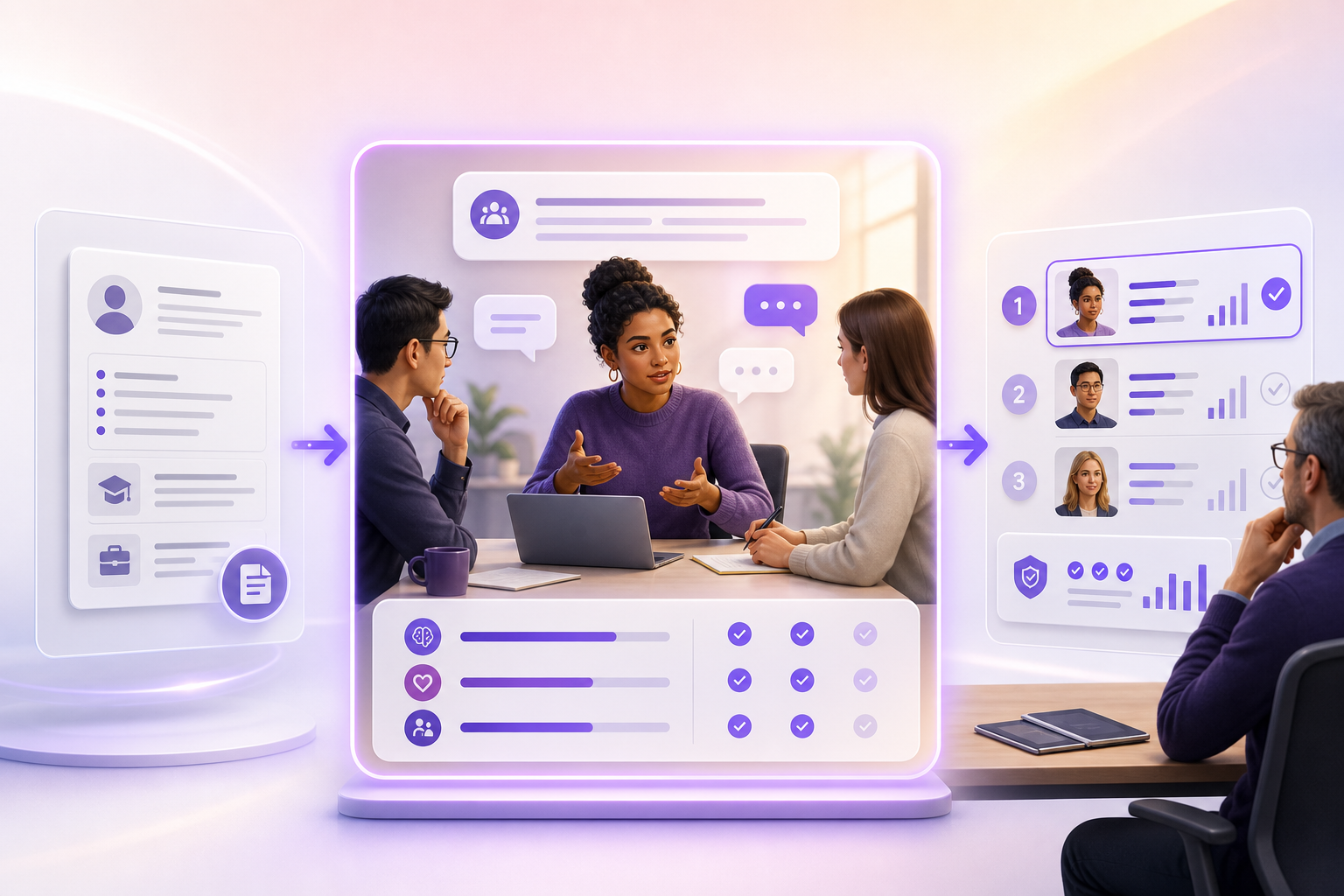
A pre-interview behavioral assessment ranks qualified candidates on how they use soft skills as they do the job, after resume screening and before the hiring manager interview. Recruiters get a scored shortlist with all 44 skills in the work, not in a separate quiz, so manager time goes to the strongest fits.
Watching someone do the work beats phone screens and personality quizzes for prediction. Unilever runs job-like screens across 43 countries; TestGorilla's 2025 survey puts skills or scenario tests at roughly three in four employers.
What is a pre-interview behavioral assessment?
A pre-interview behavioral assessment ranks qualified candidates on how they use soft skills as they do the job, after resume screening and before the hiring manager interview. Recruiters get a scored shortlist with all 44 skills in the work, not in a separate quiz, so manager time goes to the strongest fits, not whoever looked best on paper.
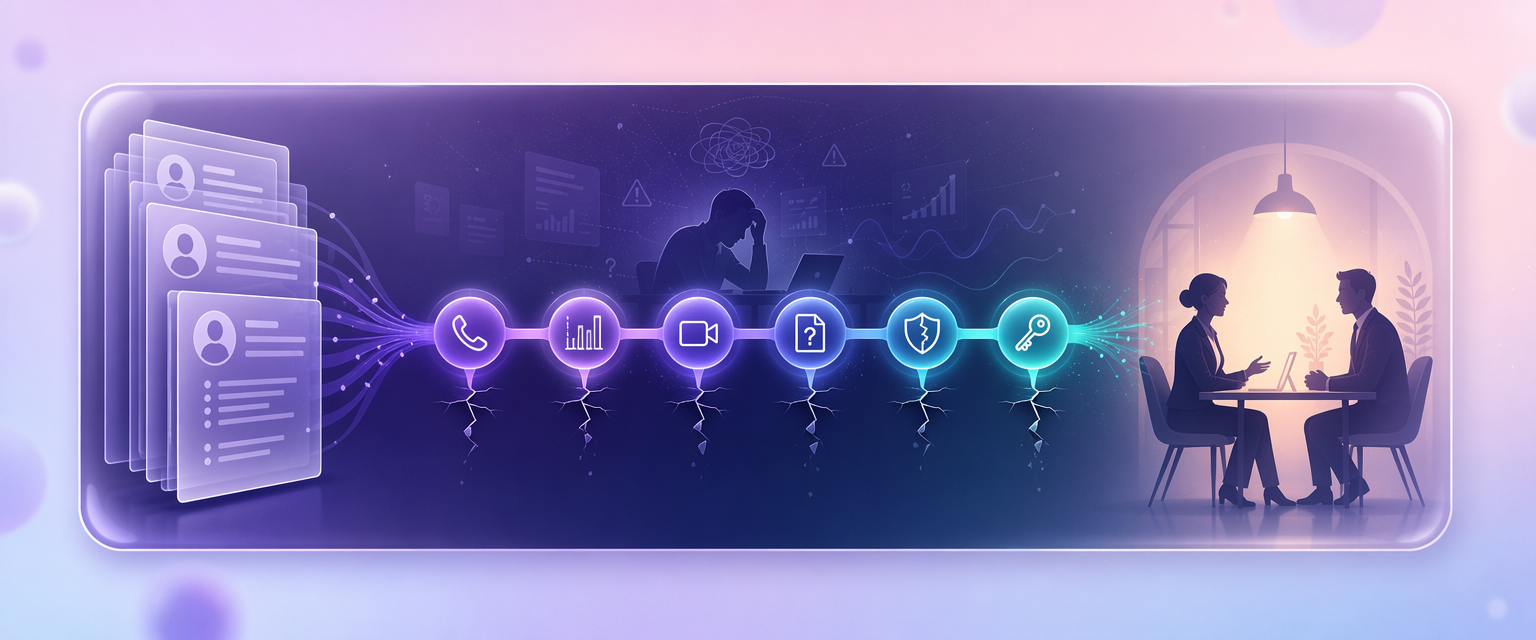
Picture the moment every recruiter knows. Fifty resumes clear the screen, all of them look fine on paper, and the hiring manager has three interview slots this week. Who gets them? Most teams answer that question with a phone screen, a gut feeling, or a personality quiz nobody fully trusts. That guess, made under pressure, is where good hires slip away and weak ones sneak through.
Instead of asking a candidate to describe themselves, you put them in the work and watch how they use the skills: write the brief, sit the meeting, hand off the task. It sits right after the resume screen and just before the manager's calendar.
What you get back is a ranked shortlist with the reasoning attached, so a manager can see why a candidate rose to the top before spending an hour with them. It is not an applicant tracking step or a sourcing tool, and it does not replace your final interview. It substitutes the questionnaire. The interview stays.
Where behavioral assessment fits in the hiring process
Run pre-interview behavioral assessment after resume screening and before the hiring manager interview. Result: managers receive a ranked shortlist backed by observed behavior.
- Step 1 Resume screening: Check experience and eligibility; Confirm basic role requirements
- Step 2 Behavioral assessment: Complete job-like tasks; See how they use the skills in the work
- Step 3 Hiring manager interview: Review behavioral evidence; Interview the strongest candidates
In this article
Table of contents for the pre-interview behavioral assessment guide.
- What is a pre-interview behavioral assessment?
- When should you use one?
- What does research say about job-scenario assessment?
- Which hiring gap does pre-interview assessment target?
- Who uses pre-interview behavioral assessment?
- How it works in practice
- How do you run pre-interview assessment correctly?
Key findings on pre-interview behavioral assessment
Job scenarios beat phone screens for prediction; adoption sits at roughly three in four employers; pilot on one role built from the job description.
- A pre-interview behavioral assessment shows you how a candidate uses soft skills as they do the job, before you spend a manager's hour on them.
- Watching someone make job decisions beats reading what they claim on a resume or a personality quiz. It is one of the stronger early signals in hiring research.
- It fixes the messy step every recruiter knows too well, the stretch between 'looks qualified' and 'the manager has time.'
- It is no longer niche. Three in four employers now run some form of skills or scenario test, and job-built scenarios are the fastest-growing type.
- Whether it works comes down to how you run it: built from the real job, piloted on one role, and checked against who actually succeeds.
When should you use one?
If you fill one senior role a year and you already know the three finalists by name, a good conversation beats any assessment.
Most recruiters are not in that situation. Applicant volume climbs, resumes start looking identical, or hiring managers keep walking out of interviews saying "nice person, wrong fit." Those are the three moments where a behavioral assessment earns its place.
Three situations where it helps
When to add a pre-interview behavioral assessment to your funnel.
- High applicant volume: Too many qualified resumes to phone-screen. You need a scalable way to rank behavior before manager time.
- Resumes look similar after AI: Candidates polish applications with AI. Paper credentials no longer separate strong fits from weak ones.
- Managers interview too many weak fits: Hiring managers repeat discovery rounds because the shortlist lacks behavioral evidence.
When one of those sounds like your last hiring cycle, the middle of your funnel needs evidence, not another document filter. Does watching someone handle a scenario predict how they will do the job? The research on that is older and more settled than most hiring tools.
What does research say about job-scenario assessment?
Researchers have spent decades comparing every common way of picking people, and the pattern holds: watching someone handle a realistic task tells you more about how they will perform than any resume, phone call, or personality quiz.
A personality test asks people to describe themselves, and most of us describe ourselves generously. A scenario asks people to act, and action is harder to fake. When a candidate has to calm a frustrated client or decide what to do about a slipping deadline, you see the instinct they will bring to the actual job.
That signal lasts longer than most hiring steps. When the UK began selecting trainee doctors with scenario tests, researchers followed the same applicants for years. The scores they earned answering "what would you do" situations at the application stage still predicted their supervisor ratings in the job seven to nine years later, even after accounting for their exam grades. A phone screen barely predicts who shows up well in the first interview; a 30-minute scenario was still telling on that same person nearly a decade on.
One honest word of caution, because the market is loud. You will see tools sold as "neuroscience," "brain-based games," or "AI personality" (Pymetrics-style games and HireVue-style video are the common examples). Strip away the branding and the good ones are doing the plain thing: putting a candidate in a job-like situation and scoring how they respond. Ask two blunt questions instead: Is the test built from my actual job? and Can you show me why a candidate scored the way they did? If a vendor cannot answer both in plain language, the science on the box will not save the hire.
What decades of hiring research keep finding about job scenarios
Peer-reviewed evidence on know-how vs self-image, long-term signal, and job-built tasks.
- It measures know-how, not self-image. A personality quiz asks people to describe themselves. A scenario asks them to act. Researchers found the second one works because it captures what someone actually knows about handling the situation, the same instinct a great candidate shows on day one. Source: Lievens & Motowidlo, 2015
- The signal holds up for years. In one long study, how people handled scenarios at the application stage still predicted how they performed on the job nearly a decade later. Few hiring signals age that well. Source: Lievens et al., 2011
- It beats the tools most teams still use. When researchers ranked every common hiring method by how well it predicts real performance, job-like tasks and structured interviews sat near the top. Personality tests and gut-feel phone screens sat near the bottom. Source: Sackett et al., 2022
- Built from the real job, it gets sharper. The scenarios that predict best are the ones written from the actual role, not bought off a shelf. Match the task to the work and the signal gets stronger; use a generic template and it fades. Source: McDaniel et al., 2007; Christian et al., 2010
Which hiring gap does pre-interview assessment target?
Nearly a century ago, militaries and large employers had already worked out that the best way to judge someone was to watch them do a sample of the work, not to interview them about it. That single principle — act it out rather than talk about it — runs through every version of this method since.
For decades the catch was cost. Watching people perform meant flying them in for a day of exercises, so only elite programs could afford it. That changed when hospitals, governments, and graduate schemes figured out how to capture the same judgment in a short written scenario. Then, in the 2010s, companies like Unilever and Goldman Sachs moved it fully online and ran it across tens of thousands of applicants before a single manager interview. What was once a luxury became something any team could send by link.
The old shortcut collapsed more recently. AI can write a flawless resume and coach a candidate through a phone script, which means the documents recruiters used to trust no longer separate anyone. That is the gap this method targets: the unnamed middle step between "the resume looks good" and "the manager has time," where teams have been guessing for years. The six hiring funnel gaps research breaks that step apart; the table and timeline show where a behavioral assessment closes the biggest holes.
Which hiring funnel gaps a pre-interview behavioral assessment closes
Unnamed middle step, weak legacy tools, resume trust collapse, and manager time waste.
- The unnamed middle step. Problem: Teams stack phone screens and tests with no shared behavioral rubric tied to the job.. How assessment helps: Names Stage 4 and measures the same behaviors the job post describes, before the manager interview.
- Weak signal from legacy tools. Problem: Phone screens and personality tests are familiar, but they are among the weakest ways to tell who will actually perform.. How assessment helps: A job scenario shows you how someone works, which is a far stronger signal than what they say about themselves on a form or a call.
- Resume signal collapse after AI. Problem: About seven in ten job seekers use AI on applications (Greenhouse, 2025).. How assessment helps: Moves signal from documents to performance evidence candidates cannot paste from a prompt.
- Hiring manager time waste. Problem: Managers interview candidates who looked good on paper but lack behavioral fit.. How assessment helps: Delivers a ranked shortlist with scores, gaps, and interview focus areas before live conversations.
How scenario-based pre-interview assessment evolved
From military work samples through online video to job-built scenarios after GenAI.
- 1920s–1970s: The military and big employers start watching people do sample tasks instead of just reading about them.. This is where the whole idea begins: judge people on what they do, not what they claim.
- 1990s–2000s: Hospitals, governments, and graduate programs adopt written 'what would you do' scenarios to screen at scale.. Proof that you can capture judgment in a short scenario without flying everyone in for a day of exercises.
- 2012–2020: Unilever, Goldman Sachs and others move screening online with recorded video and game-based tasks.. Employers show they will invest in a real pre-interview step, though many early tools felt like a black box.
- 2023–2026: AI floods applications, so teams shift from generic tests to scenarios built from the actual job.. The signal moves from the document to the task, which is exactly where a scenario shines.
Who uses pre-interview behavioral assessment?
Unilever rebuilt screening into a single scenario-and-video process running across 43 countries after facing a quarter of a million applications a year for its Future Leaders Programme. An earlier version of that rollout cut recruiting time by about three quarters and saved the company more than £1M in a single year, while giving every candidate the same fair shot. Goldman Sachs runs situational judgment and behavioral video as a structured screen before its famous Superday, so managers spend their time on people who have already shown judgment.
And in UK medical hiring, where getting it wrong is not an option, scenario-based tests have been studied across dozens of trials and consistently line up with who performs well on the ward.
Adoption climbed fast after those rollouts. According to TestGorilla's 2025 employer survey, roughly three in four employers now run some kind of skills or scenario test, and the type growing fastest is the one built from the specific job rather than bought off a shelf. A decade ago almost no mid-sized company did this. The adoption chart tracks how sharp that climb has been.
Adoption benchmarks for skills and scenario assessment
Published market and employer surveys, 2023–2026.
- Employers using skills tests (2025): 76% (TestGorilla State of Skills-Based Hiring, 2025)
- Employers using skills-based hiring (2025): 85% (TestGorilla, 2025)
- HR leaders using assessments for new hires (2023): 65% (SHL, n=1,600+ HR professionals)
- Large enterprises deploying skill assessment tests (2025): 73% (Dataintelo pre-employment testing market report)
- Job-built scenario adoption, mid-market+ (2026 est.): 32% (WiseWorld synthesis: Korn Ferry 2015, Gartner 2020, Gitnux 2023, Willo 2026)
Organizations that scaled pre-interview behavioral assessment
Documented implementations at Unilever, Goldman Sachs, and UK medical selection.
- Unilever (UFLP). Approach: Validated cognitive and behavioural assessments + structured video interviews across 43 countries. Outcome: Single global process for 250,000+ applications per year; fairer, more consistent decisions at scale. Source: Sova / Unilever TA talks, 2025
- Unilever (graduate hiring). Approach: Digital four-step flow including game-based and video assessment stages. Outcome: ~75% reduction in recruiting time; £1M+ saved in one year; 50,000+ candidate hours saved. Source: Business Insider / HireVue case
- Goldman Sachs. Approach: Online assessments including situational judgment and HireVue behavioral video for many divisions. Outcome: Structured pre-interview screen before Superday; tests judgment, teamwork, and analytical thinking. Source: Goldman Sachs campus hiring
- UK medical selection. Approach: Scenario-based judgment tests to screen for the human side of the job, beyond exam scores. Outcome: Across 37 studies, higher scenario scores lined up with stronger real-world performance. Source: Webster et al., 2020
How it works in practice
On a Tuesday afternoon, this usually means swapping the phone screens you were dreading for something the candidate does on their own time. Done right, it removes work rather than adding a stage.
It comes down to three moves.
How a pre-interview behavioral assessment works
Three steps from job description to a ranked shortlist managers can use.
- 1. Start from the job description: Extract the behaviors the post actually names (collaboration, ownership, judgment), not generic trait labels.
- 2. Send one self-paced link: Qualified candidates complete a realistic scenario mapped to those behaviors. No calendar coordination per applicant.
- 3. Receive a ranked shortlist: Recruiters get match scores, gap maps, and evidence briefs managers can use to prepare before the first live conversation.
For the candidate, that is usually 20 to 45 minutes whenever it suits them, no calendar tag with a recruiter. For you, the phone screens disappear and a ranked list appears instead. The hiring manager does not receive a pile of scores to decode. They get something they can act on in a glance.
What hiring managers receive
Deliverables from a strong pre-interview behavioral assessment step.
- Ranked shortlist with match scores
- Gap map by competency from the job description
- Suggested interview focus areas
- Behavioral evidence to review before scheduling live interviews
How do you run pre-interview assessment correctly?
Buying an assessment is easy; the vendor list is long and every demo looks impressive. Running one that actually improves your hires is a different thing. The difference is a handful of habits that separate a tool people quietly ignore from one that changes who gets hired.
None of it is complicated, but skip a step and the whole thing turns into another checkbox. Work through this before you roll anything out.
How to know you are running it correctly
Six-step checklist from job-built scenarios through six-month follow-up.
- Start from the real job, not a template: Pull the two or three behaviors that actually make or break the role, then build the scenario around those. A generic test measures generic things.
- Test the thing you care about: If the role lives or dies on how someone handles a frustrated client, put them in front of a frustrated client, not a quiz about teamwork in the abstract.
- Pilot on one opening first: Run it on a single role. Compare the shortlist it produces to how your last similar hire went. If it would have surfaced your best hire, you have your answer.
- Watch how many candidates finish: If people quit halfway, you are back to phone-screening everyone. A good scenario feels like the job and gets most people to the end; a boring quiz loses them.
- Check whether managers interview fewer duds: The real win is not a faster calendar. It is your hiring managers walking into fewer interviews that go nowhere, and debriefs that finally agree on what 'good' looks like.
- Follow the hires it recommends: Six months in, look back. Did the people it ranked highest actually do well? That loop is what turns an assessment from a nice idea into a tool you trust.
"Assessment" covers everything from a personality quiz to a full job simulation. Ignore the vendor pitch and start from your own situation. For most teams that need a behavioral shortlist before the manager interview, seeing how they use the skills as they do the job is the safest default. Soft skills for their own sake are meaningless.
Pick a starting method based on your hiring situation
Decision guide for behavioral shortlist, campus hiring, senior roles, and compliance checkboxes.
- Need a behavioral shortlist before the manager interview. Start with: Soft skills scored in the work.
- High-volume campus or hourly hiring. Start with: AI video interview, or skills scored in the work.
- Very low volume, senior role. Start with: Structured phone screen, or skills scored in the work.
- Speed only, legacy compliance checkbox. Start with: Personality inventory (weak signal; see research links).
What is the best way to assess soft skills before the hiring manager interview? After qualification, put them in the work. Score all 44 soft skills from what they do (write, create, hand off), send one self-paced link, and rank on that evidence. That beats phone screens, personality quizzes, and questionnaires. The interview stays.
For method-by-method evidence on which tools resist cheating and which ones candidates actually finish, see the links in the further-reading block.
Further reading
Related WiseWorld research on screening methods, funnel gaps, and European job-post language.
- Phone screen vs self-paced screening — cost for 20 candidates, completion rates
- Six hiring funnel gaps research — why the middle step broke
- Cheat-proof soft skills assessment research — validity, completion, and prep risk
- How to assess candidates after AI resume screening — post-GenAI workflow
- Hiring after AI: why candidates and recruiters keep automating each other
- European job-post soft skills study — what employers actually ask for
This is the step we built WiseWorld for. Paste in the job description, send one link, and get back a ranked shortlist so the manager walks into every interview already knowing how this person used the skills on the job.
WiseWorld's take: name the step, then run it
WiseWorld is a pre-interview behavioral assessment layer: paste a job description, send one self-paced link, and get a ranked shortlist with evidence before the manager interview. It replaces weak middle-step work, not stacks another stage on top.
More in Recruitment


Latest on the blog