Phone screens, personality tests, and AI video interviews: why the pre-interview step is breaking
By WiseWorld
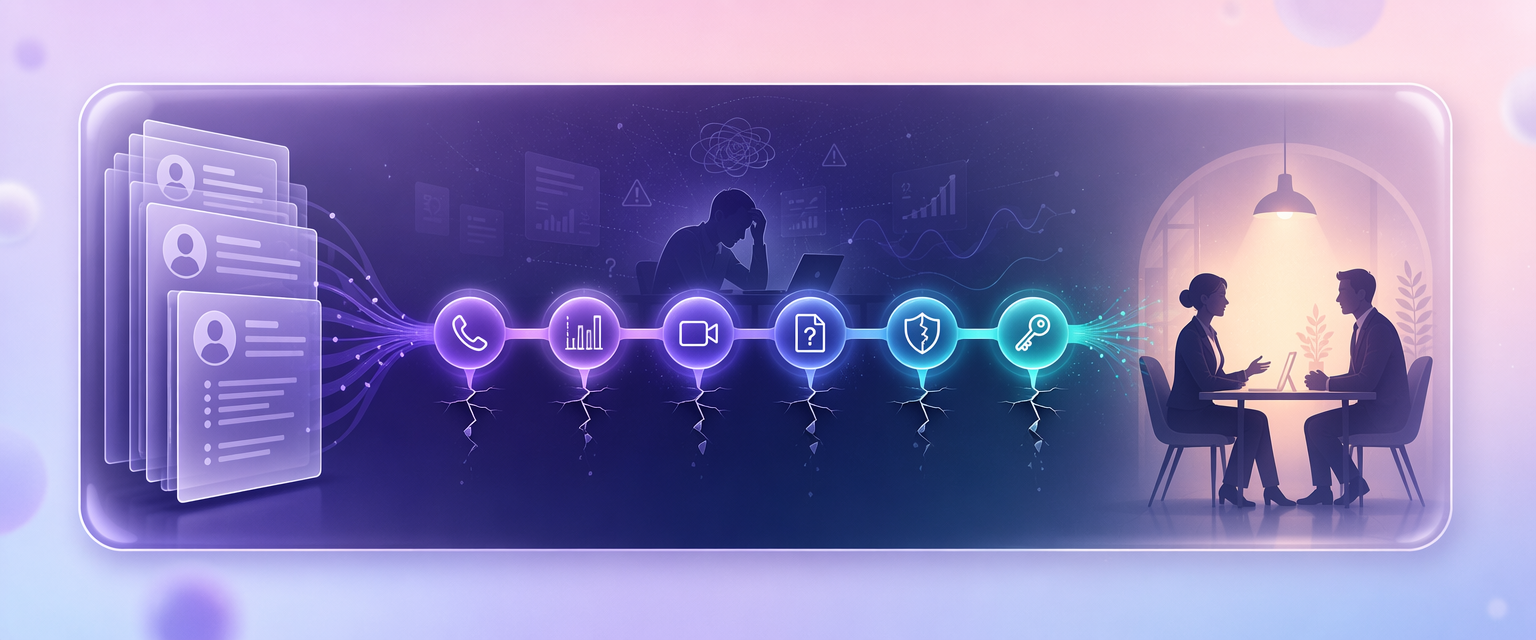
The biggest gap in hiring today is the unnamed middle step between qualification and the hiring manager interview. Phone screens, personality tests, AI video interviews, and AI resumes collide there — costing recruiter time, losing candidates, and sending weak signals forward.
This research synthesis maps six evidence-backed gaps for talent acquisition teams redesigning that step.
Introduction
The biggest gap in hiring today is the unnamed middle step between qualification and the hiring manager interview. Phone screens, personality tests, AI video interviews, and AI resumes all collide there — costing recruiter time, losing candidates, and sending weak signals forward. This article maps six evidence-backed gaps in that step for talent acquisition teams redesigning pre-interview screening.
Every hiring process has a middle. A candidate's resume looks good, but the hiring manager has not met them yet. Someone has to decide who is worth the manager's time. That decision is what this article is about.
To make it, most teams reach for the same three tools. A phone screen. A personality test. An AI video interview. Each one was added for a good reason: to protect the hiring manager's calendar, to look objective, or to handle a flood of applicants without booking live calls.
Yet the complaint at the end rarely changes. After the first real interview, the hiring manager says some version of: "They interviewed better than they work." The tools filtered a lot of people, but they did not measure whether those people can actually do the job.
That middle step is where the damage happens. Recruiters lose hours to it. Good candidates drop out of it. Weak signals pass through it. And no one can say clearly what was tested. In this article we open up that step and show six specific problems hiding inside it, using published research and real examples from companies like Unilever, Amazon, and McDonald's that have already run these tools at scale.
The layer nobody named
A hiring funnel is usually drawn as a straight line: people apply, get screened, interview, and get an offer. But there is a busy step in the middle that the diagram never labels. It sits between "this resume looks qualified" and "the hiring manager will meet them." Recruiters call it the phone screen, the personality test, the video interview, or just "a quick chat."
Leaving it unnamed causes a real problem. Your job post lists the skills you care about, such as teamwork or ownership. But this middle step rarely checks those exact skills. In our study of European software engineer job posts, employers mostly write actions, not adjectives, yet this step still rarely tests what the post describes. So candidates prepare for what the post says, and the interviewer later judges something the post never mentioned. Nobody has agreed on what this step is actually supposed to measure.
Unilever shows how large this step can grow. Before it rebuilt hiring, the company sorted 250,000 applications by hand to fill 800 graduate roles, which took four to six months (HireVue, 2019). Its fix was to add several tools in a row: first online games, then AI video interviews, then human interviews. People moved through faster. But with each tool added, it got harder to tell candidates exactly what was being judged, and why.
The phone screen tax
The phone screen is the oldest tool in this middle step, and it exists for a fair reason: a hiring manager's time is expensive, so someone has to decide who is worth a meeting. The catch is simple math. Take a mid-sized company that hires for about 60 roles a year and phone-screens roughly 30 candidates per role. That is 1,800 screens a year. At 25 minutes each, and about $45 for an hour of a recruiter's time, the phone screen alone adds up to a large bill that comes back every year.
And what do you get for it? Less than you would hope. Decades of research show that a casual, unscripted phone chat is good for breaking the ice but weak at predicting who will actually do the job well (Sackett et al., 2022). The recruiter hears a few rehearsed stories. The candidate answers "tell me about yourself" for the tenth time this month. Both spend real hours, and the result barely tells you who can do the work.
The hidden cost is scheduling. In one recruiter survey, 67% said booking a single interview takes them 30 minutes to two hours, and 35% called scheduling the most time-consuming part of their job (Yello, via Interviewstream). At high volume, the phone screen becomes calendar admin long before it becomes real evaluation.
Candidates are walking away from AI video interviews
AI video interviews were built to fix scheduling. Tools like HireVue let a company review thousands of recorded answers without booking a single live call. Through the 2010s, more employers adopted them. Then candidates began refusing to take them.
Greenhouse's 2026 research found that 38% of candidates dropped out of a hiring process once an AI interview was required. 33% pointed to the same thing: recording answers to a camera, with an AI scoring them and no human watching. The company saves time. The candidate talks to a screen and gets a score they cannot see or question. That breaks trust, and people walk away.
Unilever is the most public example. It told The Guardian (2019) that AI video screening saved 100,000 hours of recruiter time and about $1 million worldwide in a single year. Vodafone, Intel, and Singapore Airlines used similar tools. The savings were real. So was the backlash: candidates and privacy groups objected to being scored in ways they could not see, and HireVue later dropped face-scanning from new interviews after a 2019 complaint.
The risk did not disappear. In March 2025, the ACLU filed a complaint alleging that an AI video interview at Intuit blocked a deaf employee from a promotion after her request for captions was denied. The case is still open, but it shows what happens when a tool grows faster than its fairness checks.
Video is not the problem. Most companies use it the same way: the candidate records answers to stock questions, an AI scores them, and no one explains the result. Candidates know they are performing for a machine, so many rehearse a script or simply quit.
It works differently when the interview looks like the job. Ask the candidate to handle a situation they would face in the role. Tell them what you are looking for before they start. Have a person review the recording before anyone is rejected. In that setup, there is less to rehearse and more candidates finish (IJSA, 2025; Candidate Voice Report, 2026).
Personality tests are popular, but weak predictors
Personality tests arrived in hiring in the 1990s and 2000s with an appealing promise: answer some questions, and we will tell you who fits. SHL, Predictive Index, Hogan, and many others built large businesses on quick quizzes and tidy reports. Buyers still like them. The evidence is not as kind.
Researchers score how well a hiring method predicts real job performance on a scale from 0 (no better than a coin flip) to 1 (perfect prediction); higher is better. In the largest review of this research, generic personality tests score about 0.19, near the bottom. A structured interview scores about 0.42, and a realistic job simulation about 0.29 (Sackett et al., 2022). In plain terms, the personality quiz is one of the weakest predictors that many teams still lean on.
Habit has outrun the evidence. A 2026 UK survey found 56% of hiring teams still use personality tests, even though only 10% of candidates think they are fair or accurate (ThriveMap). McDonald's restaurants pilot a picture-based quiz called Traitify in their hiring app; a candidate finishes it in about 90 seconds (Bersin/Paradox). Fast and easy, yes. But 90 seconds of clicking pictures tells you very little about how someone will handle a real shift.
Both sides stopped trusting the resume
Padding a resume is old. Generative AI made it effortless and universal. By Indeed's 2025–2026 research, about seven in ten job seekers now use AI to write applications or prepare for interviews. Employers answered with more AI of their own: tools that read resumes, auto-reject, and rank applicants. Candidates automate applying; employers automate filtering; and the resume stops being something either side trusts.
That reaction makes sense. A polished resume only proves someone can produce a polished resume. It does not show whether they can set priorities under pressure, disagree with a manager politely, or explain a trade-off to a colleague, the very skills most job posts ask for. So the useful evidence has to come from something a candidate cannot simply copy, paste, or generate.
Amazon learned the danger of trusting automation too much. Reuters reported in 2018 that Amazon quietly scrapped an AI tool that ranked resumes, because it had taught itself to mark down resumes that mentioned "women's" (as in "women's chess club") and graduates of women's colleges. Engineers could not confidently make it fair, so the company shut it down. The lesson: automating the resume step does not just speed things up, it can scale hidden bias just as fast.
Every static test has an answer key
Once you stop trusting the resume, you lean on tests instead. But tests have a weakness: if the questions stay the same for everyone, someone will eventually work out the answers. Personality quizzes reward saying what the employer wants to hear. Skills-test questions leak onto Glassdoor and Reddit. Practiced interview stories get coached, and now drafted by ChatGPT. Research backs this up: fixed-question judgment tests can be gamed (Lievens and Dunlop, 2024), and candidates already use AI during recorded video interviews (Canagasuriam et al., 2025).
The rule of thumb is simple: if the questions never change, candidates can prepare for them. The way out is to make the task different each time and tied to the real job, so there is no fixed answer to look up. When a scenario responds to what the candidate just said, and comes from your own role, there is nothing to memorise in advance. People are also more willing to finish these tasks, because they feel like the job rather than a quiz (IJSA, 2025).
Unilever shows the trap. At global scale, every candidate played the same games and answered the same set questions. Efficient, but it created one shared target for the whole world to practice against, and coaching sites, review threads, and AI tools all teach people how to pass it.
For a closer look at specific tools, see our companion piece: Can candidates cheat your soft skills assessment?.
Six gaps, one matrix
On its own, each tool has a reasonable sales pitch. Phone screens protect the manager's time. Personality tests are quick and tick a box. AI video interviews handle big volumes. Skills tests confirm technical ability. Put them together, though, and you get a middle step that feels busy but still sends the wrong people to the interview.
The table below lists five companies whose choices were reported in public. None of them failed for lack of technology. They all hit the same pattern: a tool that solved one problem quietly created a new one, in trust, accuracy, or fairness.
The next table lines up all six approaches so you can compare them at a glance. Read it as a map of trade-offs, not a scoreboard, because no single option wins every column. The useful question is which problems you are actually trying to fix, whether that is cost, accuracy, candidate experience, volume, or resistance to cheating, and whether your current setup fixes more than one of them.
How each approach evolved, and where it stalled
It helps to remember that none of these tools are permanent fixtures. Each was simply a fix for the problem of its day. The phone screen came before anyone studied which interviews actually work. Personality tests spread before the research added up their weak track record. AI video interviews took off when handling huge volumes was the main pain point. And generative AI upended the resume in about three years.
Notice the pattern: each new tool answered the previous bottleneck, not a proven need for better prediction. Games and simulations appeared when keeping candidates engaged at volume was hard. Test libraries appeared when buyers wanted lots of ready-made questions. AI interviewers appeared when scheduling still hurt. Every wave solved yesterday's problem. None of them, on its own, solves today's: getting honest proof of how someone works, at scale, before the manager's interview, with no answer key to look up.
What this means for talent acquisition
You do not need six new tools. You need one honest look at that middle step.
- Name the step. Write down everything that happens between "the resume looks good" and "the manager interviews them." For each part, note what it costs, how many candidates finish it, and what it actually tells you. If you cannot say what a step measures, the candidate cannot either.
- Stop paying twice for the same weak result. A phone screen and a personality test often capture the same vague impression, once by voice and once by PDF. The research says a structured, job-like task predicts performance better than either.
- Move the real test earlier, and build it from your own job. When the task comes straight from the role, there is no public list of questions to practice. Candidates have to show how they would actually work, which is exactly what you wanted to know.
Frequently asked questions
What is the biggest gap in the hiring funnel today?
The step after qualification and before the hiring manager interview is where six problems collide: weak prediction, high recruiter cost, candidate withdrawal on AI video interviews, resume distrust, and tests candidates can prepare for. Most teams stack tools here without agreeing on what to measure for the role.
Do personality tests predict job performance?
Generic personality tests show weak links to job performance, scoring about 0.19 on a 0-to-1 scale in Sackett et al. (2022) meta-analyses. Structured interviews and job-like tasks rank higher. Teams often use personality tests for speed and familiarity, not because they are the strongest predictors.
Why are candidates withdrawing from AI video interviews?
Greenhouse's 2026 research found 38% of applicants withdrew when an AI interview was required, and 33% cited one-way video scored by AI with no human review. Candidates want clarity on what is assessed and whether a human sees the recording.
How does generative AI affect resume screening?
Roughly seven in ten job seekers now use generative AI on applications and interview prep (Indeed, 2025–2026). Employers respond with more automated filtering. Trust shifts from documents to performance-based evidence that cannot be pasted from a prompt.
Methodology
This article synthesises published research and industry surveys. It does not report a new primary dataset. We prioritised sources with public methods and hiring-specific samples.
- Validity estimates: Sackett, Zhang, Berry, and Lievens (2022) meta-analysis of selection procedure validity; scores shown as relative bars (structured interview ≈ 0.42, job simulation ≈ 0.29, personality ≈ 0.19 on a 0-to-1 scale).
- Candidate experience / AI video interview withdrawal: Greenhouse Candidate Experience Report (2026); IJSA (2025) favourability ratings; Candidate Voice Report (2026) completion rates cited in our cheat-proof assessment article.
- GenAI and trust: Indeed Hiring Lab (2025–2026); Greenhouse (2025–2026); Staffing Hub AI interview report (2026).
- Assessment gaming: Lievens and Dunlop (2024); Canagasuriam et al. (2025) on AI use in AI video interviews.
- Phone screen cost model: Illustrative model for a 400-person company, ~60 roles/year, ~1,800 candidates screened in the middle step, $45/hr loaded recruiter cost, 25-minute screens, rounded for readability. Your numbers will differ; the direction (recruiter time dominates) holds for high-volume programs.
- Funnel framing: The unnamed middle step between qualification and the hiring manager interview, where phone screens, personality tests, and AI video interviews typically stack.
- Employer case examples: Unilever/HireVue success story (2019); The Guardian (2019) on Unilever AI hiring; Reuters (2018) on Amazon resume AI; ACLU of Colorado complaint re Intuit/HireVue (2025); ThriveMap TA survey (2026); Bersin/Paradox McDonald's McHire case study on Traitify.
- Gameability index: Expert synthesis chart (same methodology as Can candidates cheat your soft skills assessment?), not a peer-reviewed metric. Useful for comparing prep risk across method families.
We interpret; we do not claim causation from cross-sectional surveys. Where vendors disagree, we cite the published number and note the limit.
More in Recruitment


Latest on the blog